Approach
Motivation
Real-world robot navigation requires a policy to understand high-level semantic goals while respecting the physical constraints of the robot during execution. Recent vision-language-action (VLA) models provide strong semantic priors for embodied decision making and navigation, but their outputs are often insufficiently grounded in robot-specific mobility. The same instruction and observation may imply different feasible routes for different platforms: a legged robot may traverse rough terrain or small height changes, whereas a wheeled robot may need to detour around them. Classical navigation systems and local planners can encode geometric safety and robot constraints, but they typically lack the open-vocabulary goal understanding and semantic flexibility of foundation models. This mismatch creates an embodiment gap between semantic navigation intent and physically executable motion on heterogeneous robots. CrossTracer addresses this gap by using a normalized pixel-space navigation trace as a shared interface between semantic intent and embodiment-aware physical grounding.
CrossTracer
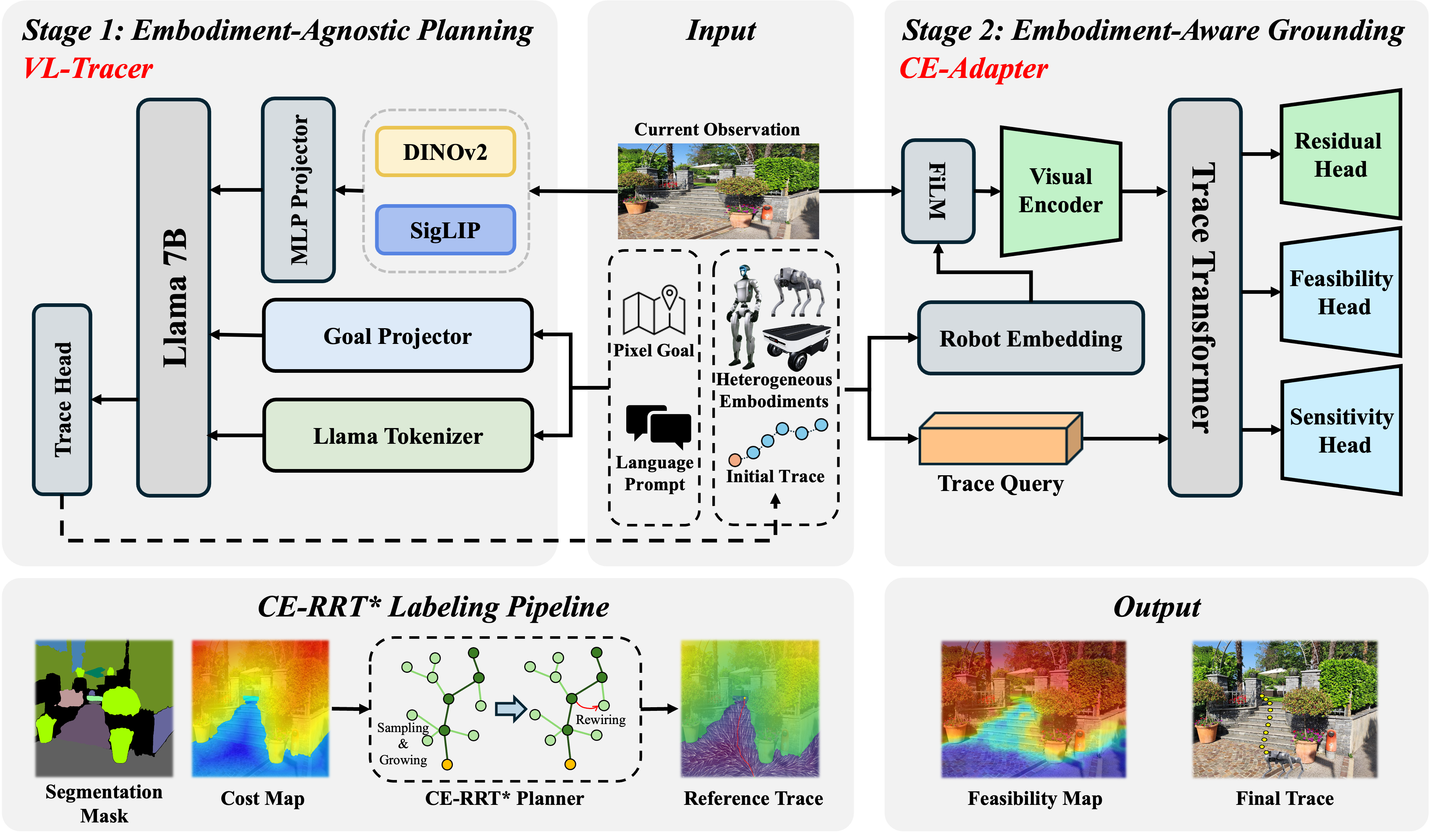
CrossTracer is a hierarchical framework that separates goal understanding from embodiment-aware physical grounding. VL-Tracer, adapted from a pretrained VLA model, first generates an embodiment-agnostic semantic trace from an egocentric RGB observation and flexible goal inputs, including language, pixel pose, or both. CE-Adapter then refines the initial trace according to visual traversability cues and the target robot embodiment. Robot identity is introduced only in this refinement stage, preventing semantic goal interpretation from becoming entangled with platform-dependent traversability. For scalable supervision, CE-RRT* converts panoptic segmentation into robot-conditioned traversability cost maps and applies RRT* planning to generate cost-minimizing reference traces in pixel space. At inference time, CrossTracer requires only the RGB observation, goal specification, and embodiment identity; semantic segmentation and precomputed cost maps are not required.
CE-Adapter
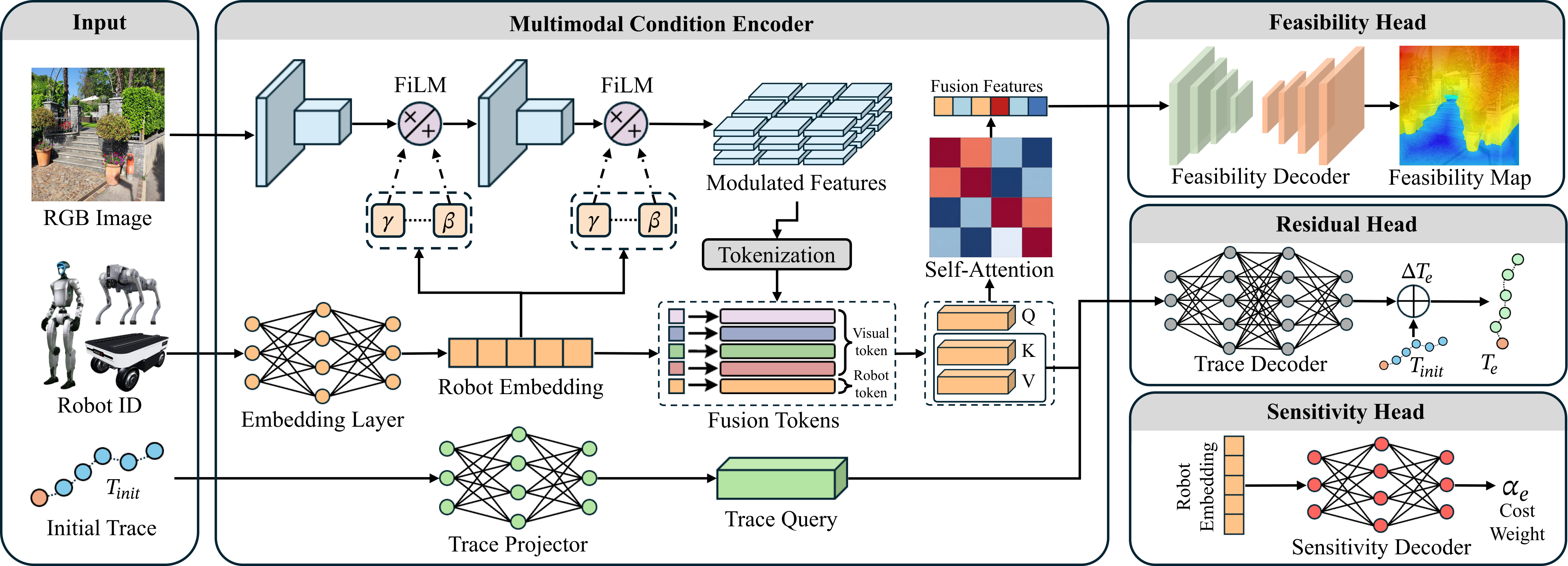
CE-Adapter refines the initial trace generated by VL-Tracer into an embodiment-conditioned trace. A learnable robot embedding modulates visual features through Feature-wise Linear Modulation (FiLM), while projected initial waypoints form trace queries that attend to embodiment-conditioned visual tokens. The Trace Residual Head predicts bounded waypoint offsets that preserve the global goal direction while correcting locally infeasible segments. During training, a Feasibility Head reconstructs the robot-conditioned traversability map and a Sensitivity Head predicts an embodiment-specific cost weight. Together with trace, physical-cost, and smoothness losses, these auxiliary objectives teach the adapter to avoid visually risky regions without discarding the semantic intent of the initial trace.
Experiments
We evaluate CrossTracer on the NaviTrace benchmark and in real-world cross-embodiment navigation tasks with wheeled and legged robots. The experiments measure semantic trace quality, embodiment-specific physical feasibility, and reliable execution across heterogeneous platforms.
NaviTrace Benchmark Results
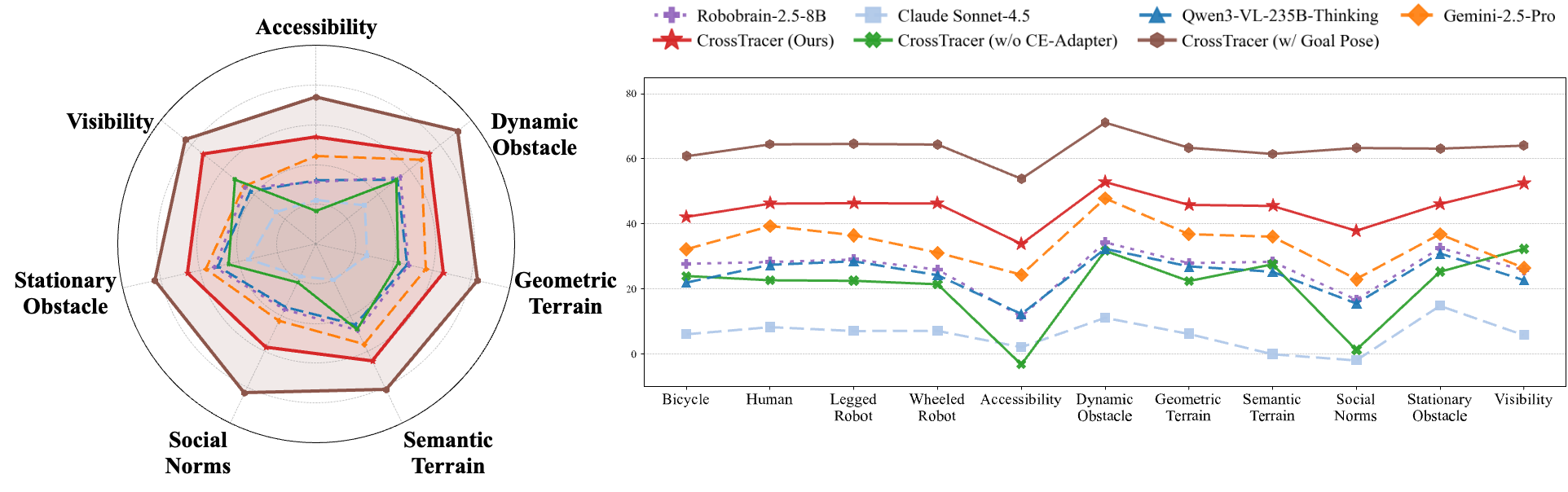
NaviTrace evaluates whether vision-language models can generate pixel-space navigation traces that are consistent with both semantic instructions and embodiment constraints. CrossTracer achieves the highest total score among the evaluated models at 45.68, improving over Gemini-2.5-Pro from 35.67 to 45.68, a relative gain of 28%. It also outperforms the strongest evaluated embodied model, Robobrain-2.5-8B, by 17.72 points. Removing CE-Adapter reduces the score to 22.56, demonstrating a 23.12-point contribution from embodiment-aware residual refinement. With an additional goal-pose input, CrossTracer reaches 63.91.
Wheeled Robot Language Navigation
CrossTracer enables wheeled robots to follow language-conditioned routes while respecting limited terrain adaptability. Across four indoor and outdoor tasks, it improves the average success rate from 0.40 to 0.65, success-weighted path length from 0.37 to 0.59, and success-weighted task time from 0.17 to 0.30 compared with OmniVLA under the same execution protocol.
Legged Robot Language Navigation
CrossTracer adapts language-conditioned traces to the mobility of a legged platform, including complex surface changes and small height variations. Across the same four tasks, it improves the average success rate from 0.45 to 0.70, success-weighted path length from 0.31 to 0.58, and success-weighted task time from 0.27 to 0.43 compared with OmniVLA.